
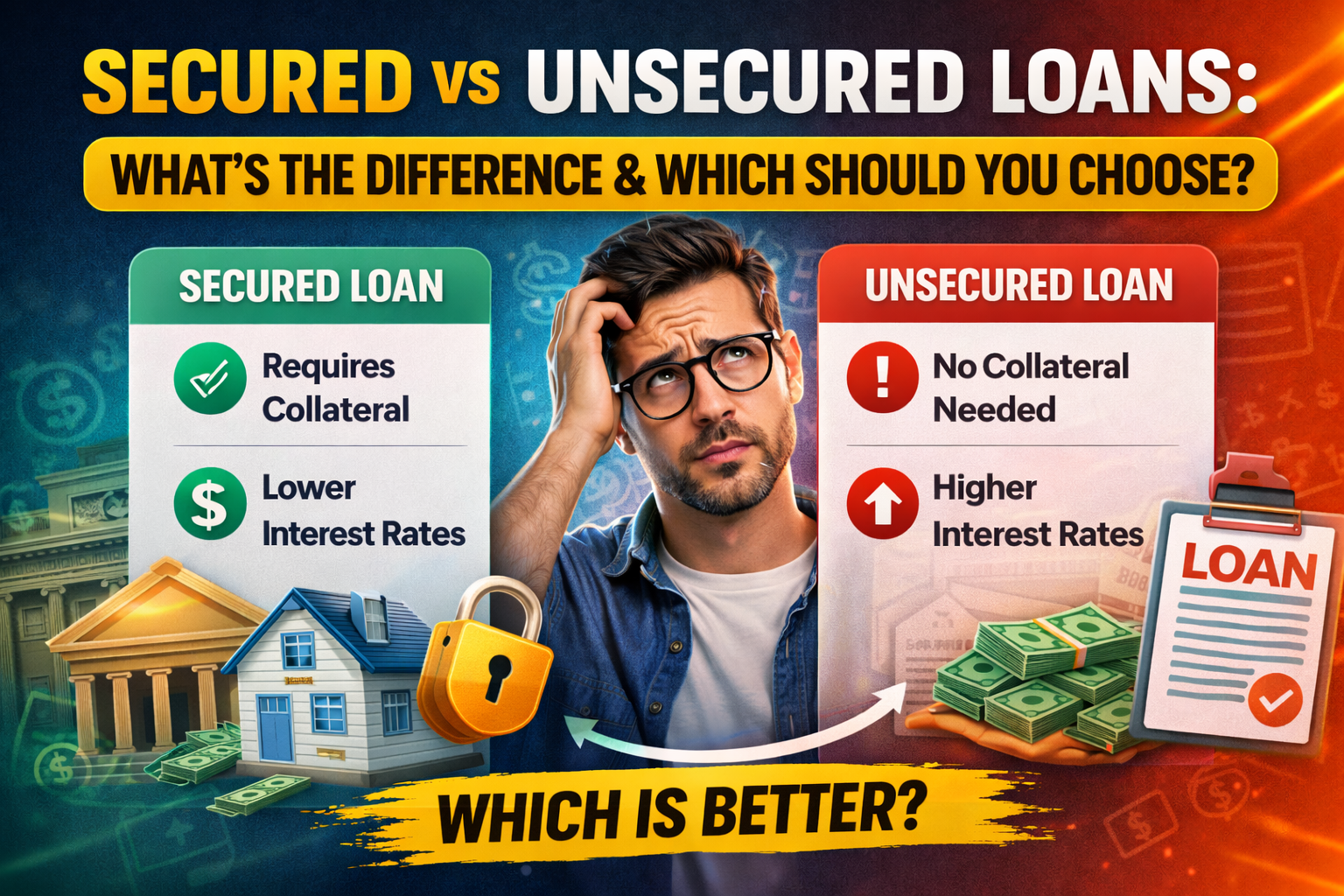
Secured vs Unsecured Loans explained in simple terms. Learn key differences, risks, interest rates, and which loan type is better for you in 2026.
Table of Contents
Introduction
Borrowing money sounds simple—until you’re asked one basic question: secured or unsecured?
That’s where most people get stuck. The difference isn’t just technical; it directly affects your risk, interest rate, and even your financial future.
Understanding secured vs unsecured loans can save you from costly mistakes. Whether you’re planning to take a loan for a home, business, or emergency, knowing how these two options work is essential.
Let’s break down secured vs unsecured loans in a way that actually makes sense—no jargon, no confusion.
What Are Secured Loans?
A secured loan is backed by collateral. This means you pledge an asset—like a house, car, or savings—as security.
If you fail to repay, the lender can take that asset.
Common Examples:
- Home loans
- Car loans
- Gold loans
- Secured business loans
What Are Unsecured Loans?
Unsecured loans don’t require collateral. Instead, lenders rely on your creditworthiness.
That means your:
- Credit score
- Income stability
- Financial history
Common Examples:
- Personal loans
- Credit cards
- Student loans
In the secured vs unsecured loans comparison, unsecured loans are easier to access but come with higher risk for lenders—and higher interest rates for borrowers.
Secured vs Unsecured Loans: Key Differences
Let’s get straight into the comparison that really matters.
1. Collateral Requirement
- Secured Loans: Require collateral
- Unsecured Loans: No collateral needed
This is the most fundamental difference in secured vs unsecured loans.
2. Interest Rates
- Secured Loans: Lower interest rates
- Unsecured Loans: Higher interest rates
Why? Because lenders take less risk with secured loans.
3. Loan Amount
- Secured Loans: Higher loan limits
- Unsecured Loans: Usually smaller amounts
When comparing secured vs unsecured loans, secured options are better for large expenses.
4. Approval Process
- Secured Loans: Slower (due to asset verification)
- Unsecured Loans: Faster approval
If speed matters, unsecured loans have the edge.
5. Risk Factor
- Secured Loans: Risk of losing your asset
- Unsecured Loans: No asset risk, but credit damage
This is where the secured vs unsecured loans decision becomes personal.
Advantages of Secured Loans
Let’s look at why people choose secured loans.
✔ Lower Interest Rates
Since lenders have collateral, they offer better rates.
✔ Higher Loan Amount
Ideal for major expenses like buying a house.
✔ Easier Approval for Low Credit
Even if your credit score isn’t great, assets can compensate.
In many cases, secured vs unsecured loans leans in favor of secured loans for affordability.
Disadvantages of Secured Loans
Of course, there are downsides.
❌ Risk of Asset Loss
Miss payments, and you could lose your property.
❌ Longer Processing Time
Documentation and valuation take time.
❌ Limited Flexibility
Not all assets qualify as collateral.
Advantages of Unsecured Loans
Now let’s flip the perspective.
✔ No Collateral Needed
You don’t risk losing assets.
✔ Faster Approval
Perfect for urgent needs.
✔ Simple Application Process
Less paperwork compared to secured loans.
In the secured vs unsecured loans debate, unsecured loans win on convenience.
Disadvantages of Unsecured Loans
But convenience comes at a cost.
❌ Higher Interest Rates
You pay more over time.
❌ Strict Eligibility
Good credit score is often required.
❌ Lower Loan Limits
Not suitable for large financial needs.
When Should You Choose a Secured Loan?
A secured loan makes sense if:
- You need a large amount
- You want lower interest rates
- You have valuable assets
- You can handle long-term commitments
In secured vs unsecured loans, secured loans are better for planned, big-ticket expenses.
When Should You Choose an Unsecured Loan?
An unsecured loan is ideal when:
- You need money quickly
- You don’t want to risk assets
- You have a strong credit score
- The loan amount is small
For short-term needs, secured vs unsecured loans often favors unsecured options.
Real-Life Example
Let’s say you need ₹5 lakh.
Option 1: Secured Loan
- Interest: 10%
- Collateral: Gold or property
- Risk: Asset loss if default
Option 2: Unsecured Loan
- Interest: 18%
- No collateral
- Risk: Higher repayment burden
This is where secured vs unsecured loans becomes a practical decision—not just theory.
Impact on Credit Score
Both loan types affect your credit score.
- Timely payments improve your score
- Missed payments damage it
However, unsecured loans rely more heavily on credit scores, making them more sensitive in the secured vs unsecured loans comparison.
Hidden Costs You Should Watch
Regardless of your choice, watch out for:
- Processing fees
- Late payment charges
- Prepayment penalties
Even in secured vs unsecured loans, hidden charges can make a big difference.
Global Perspective on Loans
Loan structures vary worldwide, but the concept remains the same.
You can explore more about lending systems on <a href=”https://en.wikipedia.org/wiki/Credit” target=”_blank”>Wikipedia</a>.
Globally, secured vs unsecured loans remains a core financial decision across all economies.
Common Mistakes to Avoid
When choosing between secured vs unsecured loans, avoid these:
- Ignoring long-term costs
- Borrowing more than needed
- Not comparing lenders
- Overestimating repayment ability
A little caution can save years of financial stress.
Conclusion
At the end of the day, secured vs unsecured loans isn’t about which is better universally—it’s about what’s better for you.
If you want lower interest and higher limits, secured loans make sense. But if speed and flexibility matter more, unsecured loans are the way to go.
Take a step back before deciding. Look at your financial situation honestly. Because choosing between secured vs unsecured loans is not just a financial decision—it’s a risk decision.
FAQ Section
1. What is the main difference between secured and unsecured loans?
Secured loans require collateral, while unsecured loans do not.
2. Which loan has lower interest rates?
Secured loans usually have lower interest rates because they are backed by assets.
3. Can I get an unsecured loan with low credit score?
It’s possible, but harder. Interest rates will likely be higher.
4. Is a secured loan safer than an unsecured loan?
It depends. Secured loans have lower rates but higher risk due to asset loss.
5. Which loan is better for emergencies?
Unsecured loans are better for emergencies due to faster approval.
6. Do both loans affect credit score?
Yes, both types impact your credit score based on your repayment behavior.
